Brickell vs Downtown Miami: Which Urban Core Condo Should You Buy?
A direct comparison of Miami's two adjacent downtown condo districts. Brickell — the established financial district with denser amenities and higher prices. Downtown Miami — the rapidly developing Worldcenter / Aston Martin / Waldorf corridor with lower entry prices and the highest transit score in Miami. Real prices, buildings, lifestyle, and who each fits.

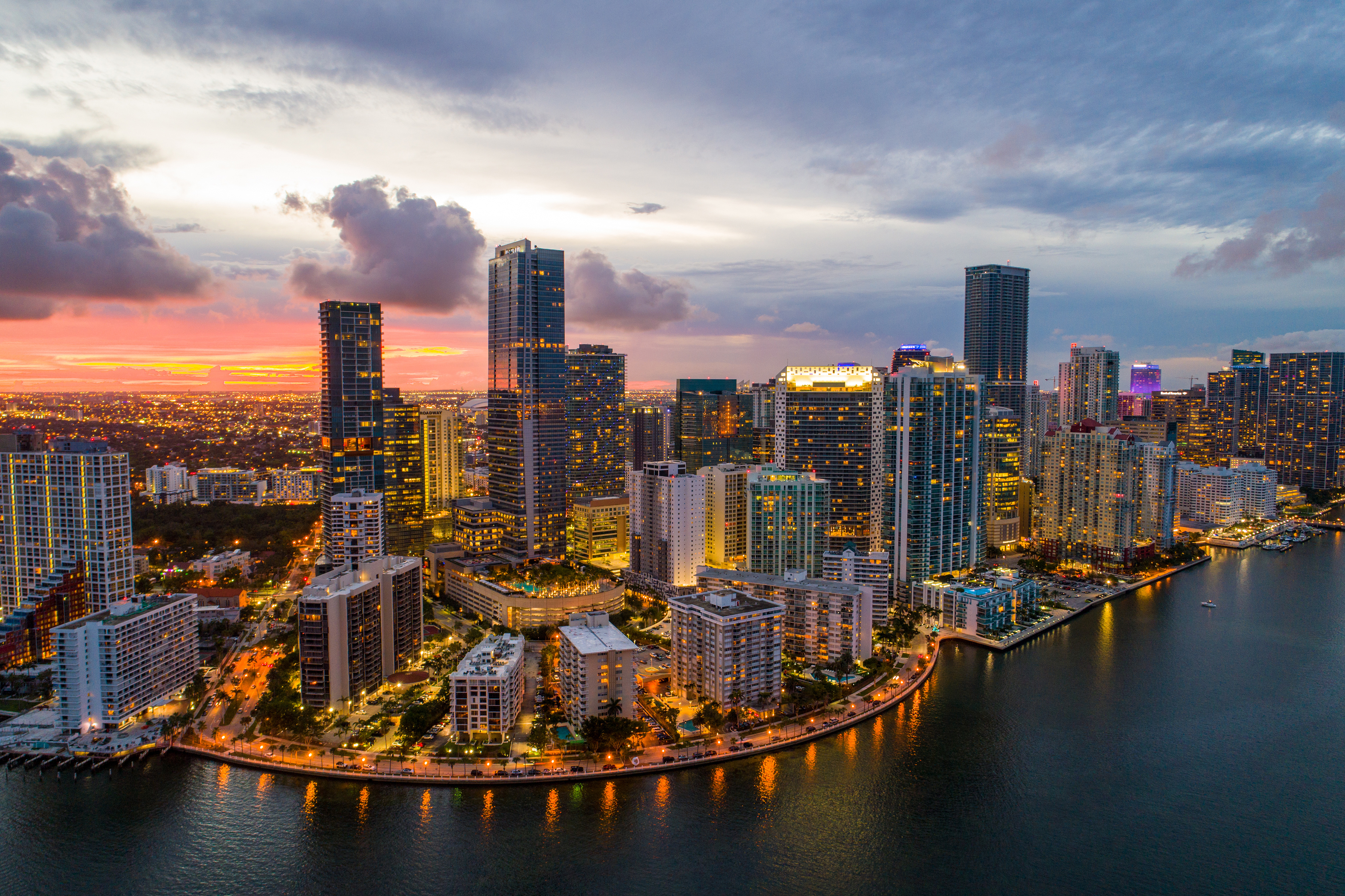
Brickell vs Downtown Miami: Which Urban Core Condo Should You Buy?
If you're shopping a Miami condo in the urban core and you've ruled out the beach (South Beach, Sunny Isles, Bal Harbour) and the bayfront luxury strips (Edgewater, Coconut Grove), two adjacent neighborhoods make every short list: Brickell and Downtown Miami.
They're literally next to each other — separated only by the Miami River. They share the Metromover. From a satellite map they look like one continuous urban core. And many buyers assume they're interchangeable variations of the same product.
They aren't. Brickell is established financial-district luxury — mature, denser, more expensive, the deeper dining and retail. Downtown Miami is the emerging supertall corridor — newer, more pre-construction, cheaper at the entry tier, with the highest transit score in Miami and the largest planned skyline transformation in the United States (Miami Worldcenter, Waldorf Astoria, Aston Martin Residences cluster).
This guide is the side-by-side.
The Quick Answer
Pick Brickell if you want established walkable dining and retail density (Mary Brickell Village, Brickell City Centre), broader inventory variety, A-rated school zoning, deeper rental tenant base, and the established financial-district address. Best for finance/corporate professionals, families wanting urban walkability with school quality, and rental investors prioritizing tenant depth.
Pick Downtown Miami if you want lower entry prices, the highest transit score in Miami (Metrorail + Metromover + Brightline), the new Worldcenter / Waldorf / Aston Martin supertall cluster, more pre-construction inventory, and the urban "frontier" upside. Best for value-conscious urban buyers, pre-construction speculators, transit-dependent commuters, and rental investors targeting yield over appreciation.
Geography & Character
Brickell sits south of the Miami River — bordered by the river to the north, Biscayne Bay to the east, Coral Way to the south, and I-95 to the west. About 1.19 square miles. The neighborhood has three distinct sub-zones: Brickell proper (the financial core), West Brickell (residential), and South Brickell (single-family + waterfront condos).
Downtown Miami sits north of the Miami River — extending from the river up to roughly NE 14th Street, bordered by Biscayne Bay to the east and I-95 to the west. About 1.5 square miles encompassing the Central Business District (CBD), the Park West / Worldcenter area, the Arts & Entertainment District, and the bayfront. Brightline's MiamiCentral station sits at the heart of Downtown — direct high-speed rail to Fort Lauderdale, West Palm Beach, and (with the recent extension) Orlando.
Character: Brickell reads as mature urban residential with the financial-district business overlay. Downtown reads as emerging supertall corridor — taller towers, larger floor plates, more construction cranes, more new product. The visual skyline of Downtown is currently changing faster than any other US neighborhood — Waldorf Astoria will be one of the tallest residential towers in the southeast US when delivered, Aston Martin Residences is already a defining silhouette at the river mouth, and the Miami Worldcenter superblock (27 acres) is mid-build with multiple residential towers underway.
The Numbers (Side by Side)
| Brickell | Downtown Miami | |
|---|---|---|
| Population | ~37,500 | ~42,500 |
| Median age | 34 | 35 |
| Median household income | $103,000 | $58,000 |
| Average condo price | $850,000 | $550,000 |
| Price per sq ft | $650 | $450 |
| Median rent | $3,200 | $2,600 |
| Rent per sq ft | $3.20 | $2.80 |
| Active inventory | ~1,250 | ~1,800 |
| Months of inventory | 4.2 | 5.5 |
| YoY price change | +12.3% | +8.5% |
| Walk Score | 97 | 91 |
| Transit Score | 90 | 100 |
| Bike Score | 75 | 78 |
| Crime rating | B | B |
| School rating | A | B |
| Nightlife rating | 5/5 | 4/5 |
| Restaurant rating | 5/5 | 4/5 |
| Shopping rating | 4/5 | 4/5 |
Reading the numbers:
- Downtown is meaningfully cheaper at every tier. Average price 35% lower ($550K vs $850K) and per-square-foot 31% lower ($450 vs $650). The same money buys substantially more square footage in Downtown.
- Downtown has the highest Transit Score in Miami (100). It's where Metrorail, Metromover, Brightline, and Tri-Rail all converge. If you're transit-dependent or commute regionally, Downtown is unmatched.
- Brickell appreciates faster (+12.3% vs +8.5% YoY) — established markets often show steeper short-term appreciation when demand outpaces supply, which Brickell currently does.
- Brickell wins schools (A vs B). Important for family buyers.
- Downtown has more inventory (1,800 vs 1,250) — partly because Downtown is geographically larger, partly because the new-construction pipeline is denser.
- Brickell has higher household incomes ($103K vs $58K) — meaningful texture about who lives in each daily.
- Both walkable (97 vs 91), but Brickell's amenity density (restaurants, retail, day-to-day services) is genuinely higher.
Building Stock
Brickell
Mature, varied. Older mid-rises through ultra-luxury operated branded towers. See our Brickell best buildings ranking for the full curated list. Notable existing inventory:
- Brickell Flatiron — 64-floor CMC Group iconic tower
- Echo Brickell — Carlos Ott ultra-luxury waterfront
- Four Seasons Residences Brickell — hotel-operated
- SLS LUX Brickell — hotel-branded
- Brickell Heights — Related Group twin-tower
Pre-construction in Brickell is one of the most active pipelines in Miami:
- St. Regis Residences Brickell
- Cipriani Residences Brickell
- Baccarat Residences Brickell
- 888 Brickell by Dolce & Gabbana
- Mercedes-Benz Places
- 619 Brickell Nobu Residences
See Brickell pre-construction ranking for the full list.
Downtown Miami
Downtown's inventory leans newer and includes the most ambitious supertall projects in greater Miami. Existing notable buildings:
- Aston Martin Residences — recently completed sail-shaped tower at the river mouth, automotive-branded
- Paramount Miami Worldcenter — the original Worldcenter residential tower
- Marquis Residences — established luxury bayfront
- Vizcayne North & South — twin tower bayfront
- 50 Biscayne — historic-meets-modern bayfront
Pre-construction in Downtown — the headline transformation:
- Waldorf Astoria Residences Miami — one of the tallest planned residential towers in the southeast US
- E11EVEN Hotel & Residences — nightclub-branded residences
- Several Miami Worldcenter residential towers ongoing
- The Crosby Worldcenter
- Legacy Hotel & Residences
See Downtown Miami best buildings and pre-construction ranking for the full inventories.
Building-stock takeaway: Brickell has more variety in tier/age and more operated-branded ultra-luxury inventory. Downtown has the newest construction at scale, the supertall pre-construction pipeline, and lower entry prices on comparable product. If you want established luxury with multiple operator brands, Brickell. If you want new-construction value or a supertall pre-construction reservation, Downtown.
Transit & Connectivity
This is Downtown's clearest win.
Downtown Miami is the convergence point of every regional transit system:
- Brightline — high-speed intercity rail to Fort Lauderdale (35 min), West Palm Beach (75 min), Orlando (3.5 hrs). MiamiCentral station is in the Worldcenter / Downtown area.
- Metrorail — Government Center Station serves Downtown
- Metromover — three lines, multiple Downtown stations
- Tri-Rail — connection at Government Center via MiamiCentral
- City of Miami Trolley — multiple Downtown routes
- PortMiami access — Downtown is the natural staging area for cruise passengers
Brickell shares Metrorail (Brickell Station) and Metromover (Brickell Loop) but doesn't have Brightline or Tri-Rail. Transit Score 90 vs Downtown's 100 reflects the actual difference.
If you commute regularly to Fort Lauderdale, Palm Beach, or Orlando — or you have family/business connections in those cities — Downtown's Brightline access is genuinely useful in a way Brickell's transit isn't.
Dining, Nightlife, Retail
Brickell wins density at the day-to-day level. Mary Brickell Village (Truluck's, Perricone's, Burger & Beer), Brickell City Centre (Saks, La Centrale, dining program), the Brickell Avenue corridor (Zuma, Komodo, Cipriani, La Mar by Gaston Acurio, Casa Tua, Sexy Fish), and South Brickell's emerging restaurant cluster collectively form the densest concentration of upscale dining in mainland Miami.
Downtown is catching up fast with the Worldcenter retail/dining program and the bayfront concentration:
- Bayside Marketplace — historic mixed retail/dining waterfront
- Worldcenter Retail Program — emerging with Saks Off Fifth, Apple, the Citadel
- The Citadel food hall — Downtown's food-hall anchor with multiple operators
- Phillip & Patricia Frost Museum of Science + Perez Art Museum Miami — cultural anchors with restaurant programs
- Riverwalk dining along the Miami River
- Bayfront restaurants at Aston Martin, 50 Biscayne, Marquis
Downtown's nightlife is increasingly competitive — E11EVEN is the centerpiece, ATV is another anchor, plus the rooftop scene at the Conrad and the W Hotel. Less variety than Brickell currently but the gap is closing as Worldcenter delivers.
Retail: comparable mid-range. Brickell City Centre vs the Worldcenter retail are roughly equivalent. Brickell wins luxury convenience (Saks, BCC's dining). Downtown wins value retail and the Bayside experience.
Schools
Brickell A vs Downtown B. The gap is meaningful but practical impact varies:
- Brickell is zoned for Southside Elementary (A-rated), Brickell International Academy (charter), Mater Brickell Preparatory Academy (charter), plus access to private options (The Cushman School, St. Stephen's Day School)
- Downtown is zoned for Riverside Elementary, Phillis Wheatley Elementary, and Booker T. Washington Senior High — generally weaker than Brickell's public zoning. Most Downtown luxury-buyer families use private schools across the river in Brickell or further south.
If schools matter strongly, Brickell wins. If you're sending to private regardless, the option set is similar (most Downtown families drive 10–15 minutes to Brickell or Coconut Grove private schools).
Investment & Market Dynamics
Brickell:
- 12.3% YoY appreciation
- Months of inventory: 4.2 (tight)
- Mature rental market — corporate, finance, attorney tenant base
- Resale liquidity is strong; comps are abundant
- Most newer Brickell buildings have explicit STR restrictions
Downtown Miami:
- 8.5% YoY appreciation
- Months of inventory: 5.5 (balanced)
- Newer inventory at lower entry prices = strong $/sqft growth potential as the neighborhood matures
- Pre-construction pipeline is enormous — Worldcenter alone has multiple residential towers in development; Waldorf Astoria delivery will be a major comp event
- Some Downtown buildings (Marquis, 50 Biscayne, certain older inventory) are STR-friendly; newer pre-con will likely restrict
- Brightline + cruise port + business travel create deep short-stay rental demand
Investor verdict: Brickell for established yields and predictable appreciation. Downtown for value entry, pre-construction speculation, and the long-term Worldcenter delivery thesis.
Who Brickell Is For
- The financial-services professional. Citadel, Goldman, the law firms — Brickell is the natural address.
- The family wanting walkable urban life with school quality. Brickell's A school zoning + walkability + amenity density is unique in urban Miami.
- The luxury-brand-conscious buyer. Brickell has the deepest concentration of operated branded condos (Four Seasons, soon St. Regis, Cipriani).
- The rental investor. Deeper, more reliable tenant pool.
- The buyer who values established density over the construction-zone energy of an emerging neighborhood.
Who Downtown Miami Is For
- The value-conscious urban buyer. $450/sqft vs $650/sqft is real. The same money buys substantially more in Downtown.
- The transit-dependent commuter. Brightline to Fort Lauderdale, Palm Beach, Orlando. No comparable corridor exists south of the river.
- The pre-construction speculator. Waldorf Astoria, Worldcenter towers, E11EVEN — Downtown's pre-construction pipeline is the largest in Miami.
- The cruise/PortMiami-affiliated buyer. Captains, executives, and frequent cruisers value Downtown's port proximity.
- The buyer betting on neighborhood maturation. The thesis: Downtown's character today is Brickell's character circa 2008. The bet is that the Worldcenter delivery cycle moves Downtown into mature-Brickell levels of amenity density over the next 10–15 years.
Frequently Asked Questions
Q: Which is cheaper, Brickell or Downtown Miami? A: Downtown by a meaningful margin. Average $550K vs $850K and $450/sqft vs $650/sqft. Comparable unit specs translate to roughly 30–35% lower prices in Downtown.
Q: Which is safer? A: Both B-rated. Brickell's day-to-day feel is slightly more polished (less unhoused population visible, more controlled commercial environment). Downtown has improved substantially over the past decade but historically had more incident concentration in certain blocks. Both are functionally safe luxury-condo environments.
Q: Which has better long-term appreciation potential? A: Brickell for steadier near-term appreciation. Downtown for higher-variance upside tied to Worldcenter and Waldorf Astoria delivery cycles. If you believe Downtown will mature into Brickell over the next decade, the per-square-foot upside is meaningful.
Q: Can I walk to work in either neighborhood? A: Yes in both for finance/legal/corporate workers. Brickell's office concentration is denser; Downtown has the Miami-Dade county government buildings, several federal offices, and increasing fintech/startup footprint at Worldcenter.
Q: Which has Brightline access? A: Only Downtown (MiamiCentral station). Brickell does not have a Brightline stop.
Q: Are there pre-construction options in both? A: Yes. Brickell pre-construction includes St. Regis, Cipriani, Baccarat, 888 Brickell, Mercedes-Benz Places, Nobu, Viceroy. Downtown pre-construction includes Waldorf Astoria, E11EVEN, multiple Worldcenter projects. Downtown's pipeline is currently larger by tower count.
Q: Which has better dining? A: Brickell currently has higher density and more 5/5-rated restaurants. Downtown is closing fast as Worldcenter and bayfront dining mature.
Q: Which is better for short-term rentals? A: Downtown has more STR-friendly buildings on average, especially older inventory (Marquis, 50 Biscayne). Brickell's newer luxury towers mostly prohibit STR. Always confirm in the specific building's condo declaration.
Q: How do I decide between them? A: Spend a Thursday in each. Brickell on a Thursday is busy and polished. Downtown on a Thursday is more rugged, more construction-active, more raw. If you value the polish, Brickell. If you value the upside thesis and can tolerate the construction-zone energy, Downtown. Both are functional luxury-condo neighborhoods, just at different points in their maturation curves.
For specific buildings in either neighborhood, browse the Brickell building directory and Downtown Miami building directory. For broader context, see the Miami neighborhoods guide, the branded residences guide, and the related Brickell vs Edgewater comparison. To talk through your specific situation, get in touch.
Tags
Kyle Benjamin
Founder of The Lieberbaum Group specializing in Miami luxury real estate.
Related Articles
Brickell vs Edgewater: Which Miami Condo Neighborhood Is Right for You?
A side-by-side comparison of Miami's two most cross-shopped condo neighborhoods. Brickell — denser, walkable, financial-district core; Edgewater — bayfront, quieter, newer construction. Real prices, building stock, walk scores, schools, lifestyle, and which one fits which buyer.
Coconut Grove vs Coral Gables: Which Miami Neighborhood Should You Buy In?
A direct comparison of Miami's two upscale family neighborhoods. Coconut Grove — bohemian bayfront village with marinas and historic charm. Coral Gables — meticulously planned Mediterranean Revival city, prestigious schools, U-Miami home. Real prices, demographics, schools, lifestyle, and who each is built for.
Sunny Isles vs Bal Harbour: Which Miami Beachfront Enclave Is Right for You?
A side-by-side comparison of Miami's two most ultra-luxury beachfront communities. Sunny Isles — the 'Florida Riviera' tower corridor with Porsche, Bentley, Ritz, Armani, and Trump branded high-rises. Bal Harbour — the ultra-curated half-square-mile enclave with St. Regis, Ritz-Carlton, and Bal Harbour Shops. Real prices, demographics, lifestyle, and which is built for which buyer.